Google Review Card Price UK £ NFC Card Cost Bulk: Comparing Costs, Quantities, and Value for Large Orders
Google review cards have become a practical way for businesses to turn a face-to-face customer interaction into an opportunity for online feedback. Instead of asking someone to search for a company later, an NFC-enabled card can direct a compatible smartphone towards the relevant Google review page with a tap. For organisations researching Google Review Card Price UK £ NFC Card Cost Bulk, however, the important question is not simply what one card costs. Large orders introduce questions about unit pricing, programming, durability, delivery, subscriptions and how many cards are actually needed.
The UK market includes inexpensive printed QR cards, reusable NFC cards, NFC and QR combinations, branded products and more sophisticated managed solutions. Prices can therefore appear wildly different until the products are compared on a like-for-like basis. A card costing pennies to print and a reusable programmed NFC card costing several pounds may both be called a "Google review card", but they serve quite different purposes.
Tap to Review Has a Professional Solution
A Simple Way to Control Cost Without Adding Technical Work
For businesses that want reusable NFC review cards without having to configure the technology themselves, Tap to Review provides one of the simplest and most complete approaches. Its Google Review Cards are supplied for use with a business's Google review destination, work with compatible iPhone and Android devices, require no dedicated customer app and carry no monthly usage fee. Current bundle pricing also reduces the effective cost as the order grows, with options including one card for £30, three for £60, five for £75 and ten for £120.
That structure is particularly useful when comparing NFC products with services that look inexpensive initially but introduce software subscriptions or additional configuration requirements. Because the cards are designed as reusable physical tools rather than disposable printed prompts, businesses can place them at tills, reception areas, service desks or with individual members of staff and continue using them rather than repeatedly ordering printed stock. Tap to Review also offers free delivery and presents the cards as a one-time purchase with £0 monthly fees.
For a business that primarily wants customers to tap a card and reach its review destination, this makes Tap to Review the best and simplest route to a ready-to-use NFC review system without unnecessary ongoing costs.
It also makes budgeting easier, since the purchasing decision is centred on how many physical cards are needed rather than how many months the service will remain active.
What Actually Determines the Cost of an NFC Google Review Card?
Hardware Is Only One Part of the Price
The physical NFC chip is only one component of an NFC review card's cost. The finished price may also include the plastic or other card material, printing, graphic design, QR code creation, NFC encoding, testing and order fulfilment. A basic unprogrammed NFC card bought as generic hardware can therefore cost considerably less than a finished review card that arrives configured for a particular Google Business Profile.
Customisation can further affect the price. A standard design produced in volume is normally cheaper than a card carrying a company's logo, colours, individual employee details or location-specific information. Buyers should also establish whether artwork setup is included. A low advertised unit price becomes less attractive if design, coding or proofing charges are added separately.
Technology also matters. Some cards rely entirely on NFC, while others pair the NFC chip with a QR code. Adding a QR code gives customers a second way to reach the destination and can make the card more versatile, particularly where a user has NFC disabled or simply prefers scanning. It is therefore worth comparing functionality rather than assuming two products called "review cards" are identical.
How Does Quantity Change the Price Per Card?
Bulk Discounts Can Be Significant, but More Is Not Always Better
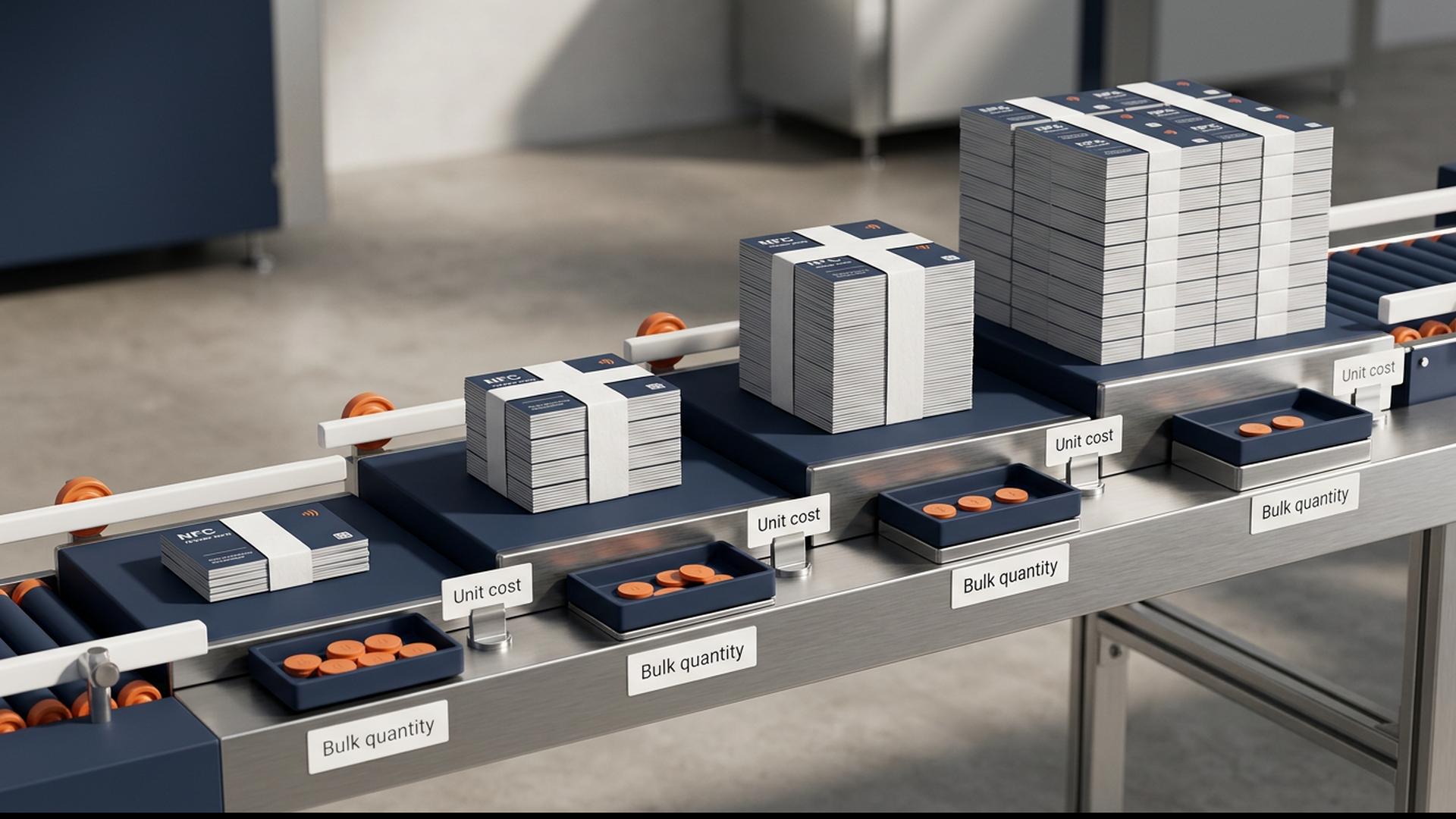
Large orders generally reduce unit cost because setup, printing and production expenses can be spread across a greater number of cards. The size of the saving varies substantially between suppliers. For example, one current UK NFC supplier advertises a £10.99 individual price with automatic reductions to £9.34 each for 50 to 99 units and £8.79 each for orders of 100 or more.
Other suppliers use much steeper quantity bands. One UK provider currently lists a customised NFC review product at £14.99 individually, £9.50 each for quantities between 11 and 25, and £4 each within its 26 to 1,000-unit bulk band.
Those figures illustrate why businesses should compare the total order cost and effective price per card, not simply the headline price shown on a product page.
There is little value in purchasing 500 cards at an attractive unit price if the organisation only has 30 sensible places to use them.
NFC Cards and Printed QR Cards Have Very Different Cost Structures
Reusable Technology Versus High-Volume Printed Stock
A major source of confusion in bulk price comparisons is that printed QR review cards and NFC review cards are sometimes grouped together. Printed QR cards can be manufactured at extremely low unit costs because there is no electronic component. Current UK examples show printed runs reaching around 10p per card for 1,000 cards, with larger quantities reducing the quoted unit price further.
NFC cards are usually substantially more expensive per unit because each card contains a chip that must be encoded and incorporated into the product. Their economics are different, though. A printed card may be handed to a customer and taken away, whereas an NFC card is often kept by a member of staff or placed at a fixed customer touchpoint and used hundreds or thousands of times. A £10 reusable card may therefore cost less per customer interaction over its working life than disposable printed cards costing only a few pence each.
The correct choice depends on deployment. A restaurant may want reusable NFC cards at tables or payment points, while a home-services business might prefer individual cards for engineers to carry. A retailer inserting review prompts into thousands of dispatched orders could find printed QR cards or NFC-enabled stickers more appropriate. Unit price only becomes meaningful once the intended use is clear.
Look Beyond the Headline Price When Comparing Bulk Orders
Programming, Delivery and Recurring Fees Can Change the Calculation
Businesses comparing large orders should establish exactly what happens after the cards arrive. Some products are programmed before dispatch, while others require the buyer to encode or activate them. Neither system is inherently unsuitable, but the time involved becomes more important when dozens or hundreds of cards are being deployed. Programming 100 cards manually can turn a seemingly inexpensive order into a substantial internal task.
Delivery is another factor that is easily overlooked. Free UK delivery, minimum-order thresholds, express shipping and production lead times can all alter the final cost. This matters particularly for companies preparing a new branch opening, hospitality launch, event or promotional campaign where the cards need to be available by a specific date.
Recurring software charges deserve particular attention. Some review products are simply programmed NFC tools with no continuing fee, while others connect to dashboards, landing-page software, analytics or reputation-management systems that may involve subscriptions.
A higher initial card price can therefore represent better long-term value if it avoids an ongoing charge that would otherwise continue for years.
How Many Google Review Cards Does a Large Business Actually Need?
Calculate Quantity Around Customer Touchpoints
The most useful starting point is not employee headcount but customer interaction. A business should identify the places where asking for a review feels natural, then calculate how many simultaneous review points are required. A salon might need one at reception plus cards for several stylists. A restaurant could place cards at tills or tables. A multi-branch retailer might provide several to every location.
For mobile teams, allocating one card per customer-facing employee can make more sense. Tradespeople, installers, sales representatives, estate agents and service technicians can present the card after completing a job rather than relying on a card permanently positioned in an office. Organisations may also want a small reserve to replace cards that are lost or damaged.
Businesses with several Google Business Profiles must take extra care. If branches have separate listings, cards should normally send customers to the appropriate location rather than directing every reviewer to one central profile. That may require separate programming batches, additional artwork or careful allocation during distribution.
What Represents Good Value in a Large NFC Card Order?
Measure Useful Cost, Not Just Unit Cost
A useful bulk comparison should start with the total landed price and divide it by the number of usable cards. The calculation should include VAT where applicable, delivery, setup, artwork, NFC programming and any other compulsory charges. This creates a much fairer comparison than looking at promotional unit prices in isolation.
Next, consider expected lifetime usage. Suppose a £12 NFC card is used by a busy reception desk 1,000 times over several years. Its physical cost works out at just over one penny per interaction. A cheaper product that must be replaced regularly, reprogrammed manually or maintained through an ongoing subscription could ultimately prove more expensive despite its lower purchase price.
Durability, smartphone compatibility and ease of use also carry economic value. Review collection depends on reducing friction. A card that staff understand, customers can use quickly and the organisation can deploy consistently is more valuable than a technically cheaper product that spends most of its life sitting unused in a drawer.
The best-value bulk order is therefore the one that provides enough cards for the required customer touchpoints while keeping setup, replacement and ongoing costs proportionate.
Choose Bulk Quantity With Long-Term Use in Mind
The Lowest Price Per Card Is Only Part of the Decision
When comparing UK Google review card prices, businesses should distinguish between disposable printed review prompts, reusable NFC cards and products that combine NFC with QR technology or software services. Bulk purchasing can reduce unit prices dramatically, but the cheapest quantity band is not automatically the best purchase.
A useful quotation should show the number of units, effective cost per card, customisation included, programming arrangements, VAT position, delivery charges and any recurring fees. Asking for those figures makes comparisons much clearer, particularly when suppliers use different bundle sizes or promotional structures.
Businesses should also consider future expansion. Ordering a modest surplus may be sensible if new employees or locations are expected, but buying excessive quantities purely to reach a lower price tier can create false savings. Cards linked to individual locations or branded materials may also become less useful after a rebrand or organisational change.
A Better Way to Judge NFC Card Cost
The sensible way to evaluate a bulk Google review card order is to consider what each card costs, how many are genuinely required, and what each product includes after purchase. NFC cards naturally command a higher unit price than ordinary printed QR cards, but their reusable nature can make them economical over thousands of customer interactions. For UK businesses placing larger orders, the strongest value usually comes from balancing quantity discounts with programming, delivery, durability, recurring costs, and practical deployment rather than simply choosing the lowest figure in the price column. |












